
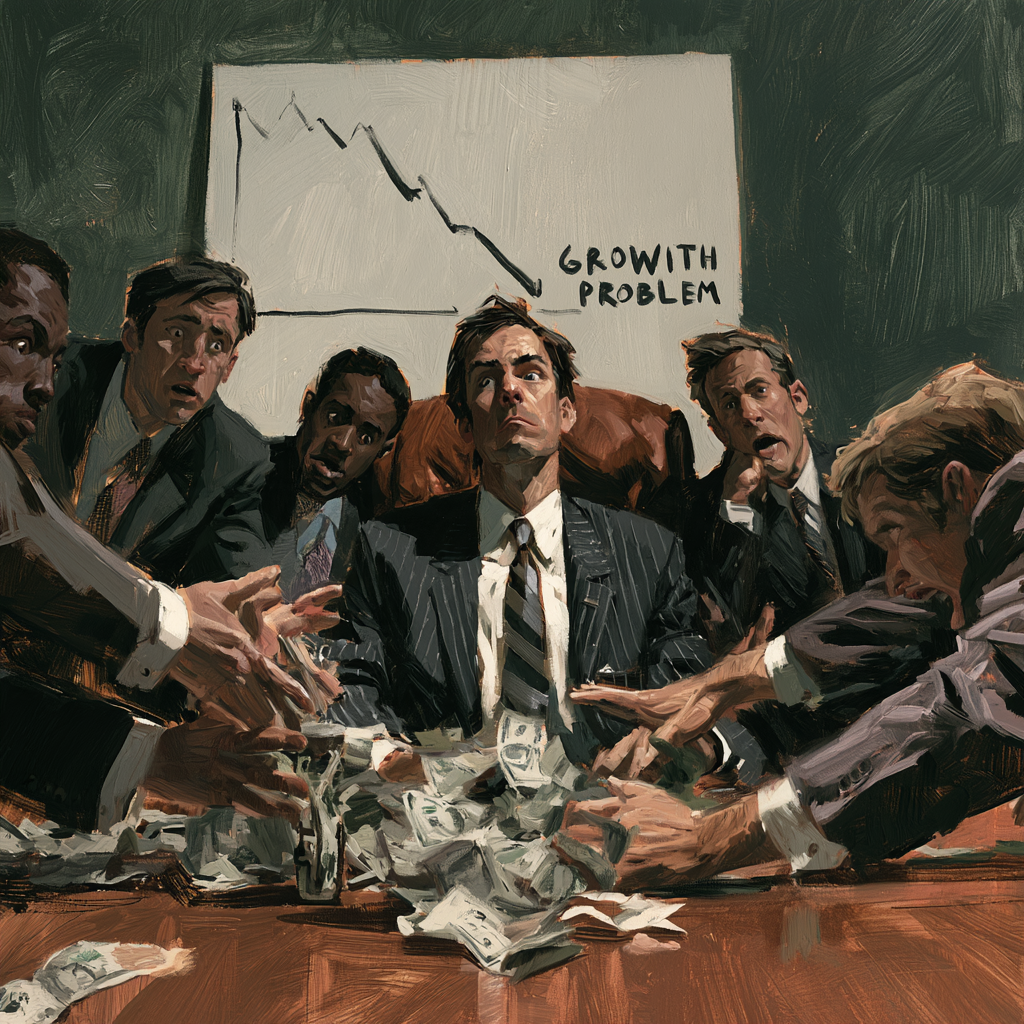
There is a dangerous moment in the life of a technology company.
It happens after the product has been proven, customers have been won, investors have written checks, and the board begins asking the obvious question:
Why aren’t we growing faster?
This is particularly common among technology companies serving the built environment.
The company may have a strong platform. Customers like it. Reference accounts exist. The market opportunity appears substantial. The company has hired salespeople, attended the conferences, built partnerships, increased marketing, and created increasingly sophisticated forecasts.
Yet growth remains stubbornly inconsistent.
The usual reaction is to add more.
More salespeople. More marketing. More leads. More technology. More management. More meetings.
Private equity introduces another ingredient: more pressure.
None of these necessarily addresses the problem.
In fact, capital often does something founders and investors underestimate.
It exposes weaknesses that were already there.
The Problem May Not Be Sales
When revenue disappoints, the sales organization usually receives the first examination.
That makes sense, but it can also be lazy diagnosis.
A sales problem is visible. The underlying business problem often isn’t.
Perhaps the company hasn’t clearly defined its ideal customer. Maybe the product is being sold to facilities executives, energy leaders, operations teams and sustainability executives with essentially the same message.
Perhaps the company has confused product capability with customer value.
Or the pricing model evolved one deal at a time and now bears little relationship to the value being created.
Maybe the sales organization is pursuing too many markets because management fears saying no to revenue.
Perhaps pilots are plentiful, but conversions aren’t.
Or the company is winning $75,000 transactions while its cost structure and investor expectations require $500,000 relationships.
Hiring three additional salespeople won’t fix any of those problems.
It merely gives you three more people pursuing a flawed strategy.
Founders Have a Unique Blind Spot
Founders know their businesses extraordinarily well.
Sometimes too well.
They remember why the company was created, how the product evolved, what early customers requested, which features competitors lack and why the technology is technically superior.
Customers don’t buy any of that history.
They buy an outcome.
This distinction becomes particularly important in the built environment because technology companies frequently become enamored with what their products can do.
Artificial intelligence. Machine learning. Digital twins. Fault detection. IoT sensors. Predictive analytics. Automated workflows. Remote monitoring.
Interesting technology isn’t necessarily compelling business value.
The CFO isn’t buying fault detection.
The CFO may be buying a reduction in unnecessary service calls across 1,500 locations.
The COO isn’t buying artificial intelligence.
The COO may be buying fewer equipment failures during operating hours.
The facilities executive isn’t buying another dashboard.
That executive may desperately want fewer systems, better vendor accountability and enough credible information to determine where a limited capital budget should be spent.
The distinction sounds simple.
It isn’t.
It affects positioning, pricing, sales conversations, product priorities, partnerships and ultimately valuation.
Private Equity Changes the Conversation
The founder asks, “How do we grow?”
The investor asks a different question:
“How do we make growth repeatable?”
That’s an important distinction.
Private equity isn’t investing simply because a company has interesting technology.
Investors are underwriting future enterprise value.
That requires some combination of revenue growth, recurring revenue, margin expansion, customer retention, market expansion, operating discipline and ultimately a credible path to an attractive exit.
The company therefore has two clocks running simultaneously.
Management is operating the business today.
The investor is measuring progress toward tomorrow’s value creation thesis.
Trouble begins when those clocks aren’t synchronized.
Management believes the company is making progress because the pipeline increased 30 percent.
The board sees that conversion rates haven’t improved.
The CEO celebrates three new enterprise customers.
The investor notices implementation costs are rising faster than recurring revenue.
Sales points to $20 million in pipeline.
The board asks how much of it is actually qualified.
Everyone may be looking at accurate information and reaching different conclusions.
This Is Where Outside Perspective Matters
The best outside advisors don’t arrive with a 100-page presentation explaining what management already knows.
Nor should they attempt to run the company from the sidelines.
Their value is different.
They create clarity.
A strong advisor can move between the CEO, leadership team and investor without carrying the organizational baggage that inevitably develops inside a company.
They can ask questions employees may hesitate to ask.
Why are we pursuing this market?
Why does this customer buy from us?
Why do we keep losing after the pilot?
Why are sales cycles getting longer?
Why is this partnership strategic?
Why are we pricing this way?
Why do we believe this pipeline?
Why are we hiring another salesperson?
And perhaps the most valuable question:
What evidence would cause us to admit that our current assumption is wrong?
Those questions can be uncomfortable.
They are also considerably cheaper than another year of missed expectations.
Experience Matters More Than Methodology
There is another issue unique to technology serving the built environment.
This market looks easier from the outside than it actually is.
Buildings don’t buy technology.
Organizations do.
And the organizations responsible for large portfolios of buildings can be remarkably complex.
A technology provider selling into retail, restaurants, grocery, healthcare, banking or other multi-site environments may encounter facilities, operations, construction, procurement, IT, finance, sustainability, security and executive leadership before a meaningful deployment occurs.
Each stakeholder views value differently.
That makes industry experience important.
An advisor who understands technology but doesn’t understand facilities operations will miss part of the equation.
An advisor who understands facilities but doesn’t understand commercialization will miss another.
And someone who has never carried a revenue number may offer elegant advice that collapses upon contact with an actual customer.
Companies don’t need more theory.
They need judgment.
The Advisor Should Serve the Enterprise, Not the Politics
This is where an advisory relationship can become especially valuable in a private-equity-backed company.
The advisor shouldn’t become “the CEO’s person.”
Nor should the advisor become “the PE firm’s person.”
Both destroy credibility.
The responsibility is to the success of the enterprise.
Sometimes that means telling investors that management needs more time.
Sometimes it means telling management that time isn’t the problem.
Sometimes the strategy is right and execution is poor.
Sometimes execution is excellent and the strategy is wrong.
Sometimes the company needs additional resources.
And sometimes it needs fewer priorities.
Independent judgment is valuable precisely because it isn’t attached to an organizational chart.
The Objective Isn’t Advice
Companies don’t improve because they receive good advice.
They improve because something changes.
A market becomes a priority.
Another market is abandoned.
Pricing changes.
A sales process becomes more disciplined.
The value proposition becomes sharper.
An executive makes a difficult personnel decision.
A partnership is terminated.
Resources move.
Accountability becomes visible.
A CEO spends less time defending yesterday’s assumptions and more time making tomorrow’s decisions.
That’s the standard by which an advisory relationship should be judged.
Not meetings.
Not presentations.
Not hours.
Results.
Private equity can provide capital, relationships and governance.
Management provides leadership, knowledge and execution.
A strong advisory partner occupies the space between them - challenging assumptions, translating strategy into action and helping both sides distinguish activity from progress.
That’s particularly important when a technology company enters the difficult transition from proving that its product works to proving that its business can scale.
The first requires innovation.
The second requires discipline.
And confusing the two can become extraordinarily expensive.
The question for CEOs and investors isn’t whether the company has smart people around the table.
It almost certainly does.
The better question is:
Who around that table has both the independence and the experience to tell you what you may not want to hear - before the market does?
If this article resonates with you and you’d like to start a conversation - contact Efficio .